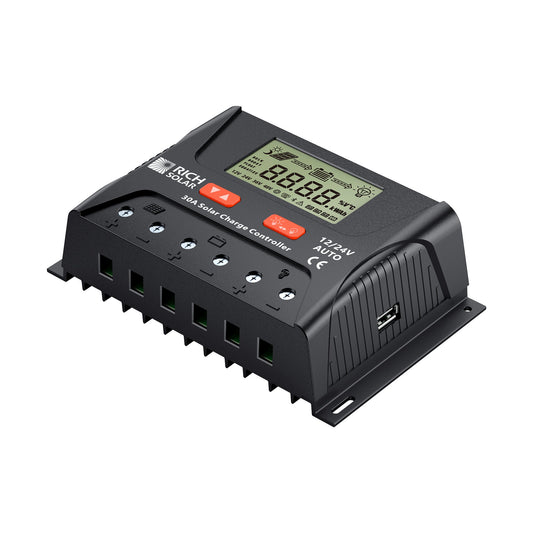
Compare solar charge controllers and related installation kits. Match the controller to your battery voltage and chemistry, solar-array limits, and charging needs, then check the exact model’s features and included accessories.
Choose a solar charge controller by system limits, not amperage alone
Use this collection to compare solar charge controllers and related installation kits across the brands below. The current mix includes MPPT, PWM, waterproof and flush-mount PWM, plus DC-DC charging with MPPT. Product mix and storefront availability can change.
Start with the battery bank
Confirm the exact controller supports the battery bank's nominal voltage, battery chemistry, charge profile and allowable charging current. Do not assume a controller supports a battery merely because both are described as 12V or 24V.
Check the complete solar array
Compare the array's series and parallel layout with the controller's maximum PV open-circuit voltage, operating window, input current and supported solar power. Cold weather can raise panel Voc, so use the exact panel temperature coefficient and the site's lowest expected temperature.
Choose MPPT, PWM or DC-DC for the actual job
MPPT is commonly considered when array voltage is higher than battery voltage or when a larger array needs a wider operating range. PWM can fit smaller, voltage-matched systems. DC-DC charging with MPPT is a separate mobile-system pathway that can combine alternator and solar charging. Verify the exact manual before choosing.
Verify monitoring, sensors and included parts
Bluetooth, displays, temperature sensing, remote monitoring, tray cables and mounting hardware vary by exact model and package. A compatible port or product-family name is not proof that an accessory is included.
Before installation: confirm conductor sizing, overcurrent protection, disconnects, grounding, environmental ratings and the current manufacturer instructions. Use a qualified professional where the installation, voltage, location or local rules require one.